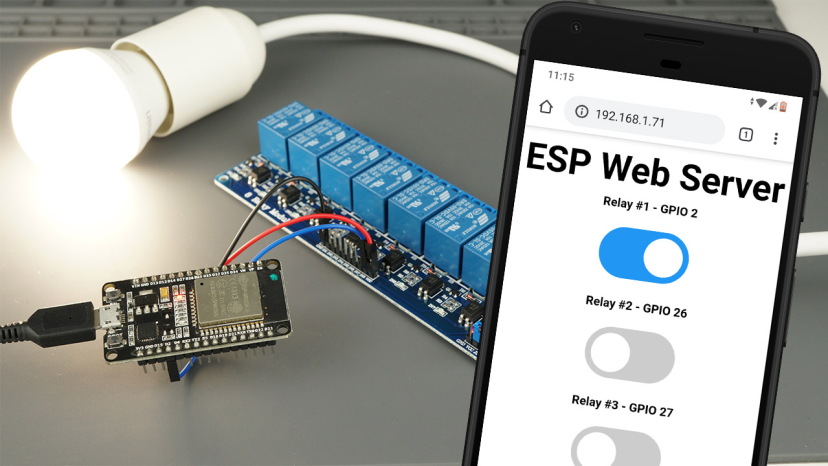
Hardware Setup
- ESP32 Board: Ensure your ESP32 is connected to a compatible display (e.g., an SPI-based TFT or similar).
- Touch Display: Use a display that supports LVGL and includes a touch panel (e.g., ILI9341 with XPT2046 touch controller).
- 4-Channel Relay: Connect the relay inputs to GPIO pins of the ESP32, ensuring they are correctly powered (usually 5V for most relay modules).
- Wiring:
- Connect relay IN1, IN2, IN3, IN4 to ESP32 GPIOs (e.g., 25, 26, 27, 14).
- Provide a common ground between the ESP32 and the relay module.
Software Setup
-
Install LVGL:
- Use the LVGL library to create a GUI for controlling the relays.
- Install the library using PlatformIO or Arduino Library Manager.
-
Touch Driver:
- Ensure the correct driver (e.g., XPT2046) is configured in your LVGL setup.
- ESP32 Board: Ensure your ESP32 is connected to a compatible display (e.g., an SPI-based TFT or similar).
- Touch Display: Use a display that supports LVGL and includes a touch panel (e.g., ILI9341 with XPT2046 touch controller).
- 4-Channel Relay: Connect the relay inputs to GPIO pins of the ESP32, ensuring they are correctly powered (usually 5V for most relay modules).
- Wiring:
- Connect relay IN1, IN2, IN3, IN4 to ESP32 GPIOs (e.g., 25, 26, 27, 14).
- Provide a common ground between the ESP32 and the relay module.
Software Setup
Install LVGL:
- Use the LVGL library to create a GUI for controlling the relays.
- Install the library using PlatformIO or Arduino Library Manager.
Touch Driver:
- Ensure the correct driver (e.g., XPT2046) is configured in your LVGL setup.
arduino
#include <lvgl.h>
#include <TFT_eSPI.h> // TFT library for SPI displays
#include <Wire.h>

// Define relay GPIO pins
#define RELAY1_PIN 25
#define RELAY2_PIN 26
#define RELAY3_PIN 27
#define RELAY4_PIN 14

TFT_eSPI tft = TFT_eSPI(); // Initialize display
lv_disp_draw_buf_t draw_buf;
lv_color_t buf[LV_HOR_RES_MAX * 10]; // Display buffer

// Function to control relays
void toggle_relay(uint8_t relay, bool state) {
  digitalWrite(relay, state ? LOW : HIGH); // Relay logic: LOW = ON, HIGH = OFF
}

// Callback functions for buttons
void btn_relay1_event_cb(lv_event_t *e) {
  static bool state = false;
  state = !state;
  toggle_relay(RELAY1_PIN, state);
}

void btn_relay2_event_cb(lv_event_t *e) {
  static bool state = false;
  state = !state;
  toggle_relay(RELAY2_PIN, state);
}

void btn_relay3_event_cb(lv_event_t *e) {
  static bool state = false;
  state = !state;
  toggle_relay(RELAY3_PIN, state);
}

void btn_relay4_event_cb(lv_event_t *e) {
  static bool state = false;
  state = !state;
  toggle_relay(RELAY4_PIN, state);
}

void setup() {
  Serial.begin(115200);

  // Initialize relay pins
  pinMode(RELAY1_PIN, OUTPUT);
  pinMode(RELAY2_PIN, OUTPUT);
  pinMode(RELAY3_PIN, OUTPUT);
  pinMode(RELAY4_PIN, OUTPUT);
  toggle_relay(RELAY1_PIN, false);
  toggle_relay(RELAY2_PIN, false);
  toggle_relay(RELAY3_PIN, false);
  toggle_relay(RELAY4_PIN, false);

  // Initialize display
  tft.begin();
  tft.setRotation(1);

  // Initialize LVGL
  lv_init();
  lv_disp_draw_buf_init(&draw_buf, buf, NULL, LV_HOR_RES_MAX * 10);

  // Set up display driver
  static lv_disp_drv_t disp_drv;
  lv_disp_drv_init(&disp_drv);
  disp_drv.hor_res = 320;
  disp_drv.ver_res = 240;
  disp_drv.flush_cb = [](lv_disp_drv_t *disp, const lv_area_t *area, lv_color_t *color_p) {
    tft.startWrite();
    tft.setAddrWindow(area->x1, area->y1, (area->x2 - area->x1 + 1), (area->y2 - area->y1 + 1));
    tft.pushColors(&color_p->full, (area->x2 - area->x1 + 1) * (area->y2 - area->y1 + 1), true);
    tft.endWrite();
    lv_disp_flush_ready(disp);
  };
  disp_drv.draw_buf = &draw_buf;
  lv_disp_drv_register(&disp_drv);

  // Create buttons
  lv_obj_t *btn1 = lv_btn_create(lv_scr_act());
  lv_obj_set_size(btn1, 80, 40);
  lv_obj_align(btn1, LV_ALIGN_TOP_LEFT, 20, 20);
  lv_obj_t *label1 = lv_label_create(btn1);
  lv_label_set_text(label1, "Relay 1");
  lv_obj_center(label1);
  lv_obj_add_event_cb(btn1, btn_relay1_event_cb, LV_EVENT_CLICKED, NULL);

  lv_obj_t *btn2 = lv_btn_create(lv_scr_act());
  lv_obj_set_size(btn2, 80, 40);
  lv_obj_align(btn2, LV_ALIGN_TOP_LEFT, 120, 20);
  lv_obj_t *label2 = lv_label_create(btn2);
  lv_label_set_text(label2, "Relay 2");
  lv_obj_center(label2);
  lv_obj_add_event_cb(btn2, btn_relay2_event_cb, LV_EVENT_CLICKED, NULL);

  lv_obj_t *btn3 = lv_btn_create(lv_scr_act());
  lv_obj_set_size(btn3, 80, 40);
  lv_obj_align(btn3, LV_ALIGN_TOP_LEFT, 20, 80);
  lv_obj_t *label3 = lv_label_create(btn3);
  lv_label_set_text(label3, "Relay 3");
  lv_obj_center(label3);
  lv_obj_add_event_cb(btn3, btn_relay3_event_cb, LV_EVENT_CLICKED, NULL);

  lv_obj_t *btn4 = lv_btn_create(lv_scr_act());
  lv_obj_set_size(btn4, 80, 40);
  lv_obj_align(btn4, LV_ALIGN_TOP_LEFT, 120, 80);
  lv_obj_t *label4 = lv_label_create(btn4);
  lv_label_set_text(label4, "Relay 4");
  lv_obj_center(label4);
  lv_obj_add_event_cb(btn4, btn_relay4_event_cb, LV_EVENT_CLICKED, NULL);
}

void loop() {
  lv_timer_handler(); // Handle LVGL tasks
  delay(5);
}
-
Explanation
-
Relay Control:
- GPIO pins (e.g., 25, 26, 27, 14) are set as outputs to control the relay.
- Logic is inverted for most relay modules (LOW = ON, HIGH = OFF).
-
LVGL GUI:
- Buttons are created for each relay.
- Event callbacks toggle the relay state.
-
Touch and Display:
- LVGL handles the touch input and draws the interface on the display.
- The display flush callback sends pixel data to the screen.
-
Performance:
- The
lv_timer_handler()ensures smooth touch and GUI updates.
- The